Sustainability is one of our core values and our main driving force during our history. Our vision is to be the most valued business partner providing pioneering materials solutions for a sustainable world, meaning we want to help industries develop sustainable products with innovative properties.
In order to live by our vision and our core value, high demands are placed on the entire organization to constantly develop and improve the three dimensions within sustainability: social solidarity, environmental responsibility, and economic efficiency.
Svenska Aerogel has become the first Swedish listed company to be verified according to ISO 26000, an international standard focusing on corporate social responsibility (CSR). The verification has been carried out by an accredited third party, VERIFY Agency of Sweden, which has reviewed Svenska Aerogel’s sustainability work.
The work that led to the ISO 26000 verification of our sustainability processes complements our already certified and standardized way of working. This external recognition is important for us because it shows that our long-term, systematic work with sustainability is bearing fruit and that our employees, customers, investors, and authorities can have trust in our sustainability focus.”
Tor Einar Norbakk, CEO
By prioritizing and focusing on selected goals from the United Nations Sustainable Development Goals (SDGs) 2030, we will contribute to the Agenda 2030 transition. Based on our strategy and business plan, we have chosen three of the SDGs, which we have divided into different sub-goals with concrete activities. The selection process was based on where we have the most influence and where we have the greatest opportunity to contribute to a positive change. The goals are integrated into our business and sustainability strategy and are continuously followed up in connection with the company’s business and sustainability goals.
Quartzene is produced in a patented waterborne process utilising commonly available silica source, water, and green energy. By adding Quartzene, insulation against heat, cold, sound and fire can be improved in end products. The improved insulation effect saves energy in several stages, reduces weight and material consumption, and increases safety – often Quartzene contributes to a combination of all these things.
Basically, it’s about us developing sustainable solutions in products with the smallest possible impact on the environment. Quartzene is a contributing factor for global manufacturing industries that strive to reach the SDGs by 2030.
Quartzene is produced in a patented waterborne process utilising commonly available silica source, water, and green energy. By adding Quartzene, insulation against heat, cold, sound and fire can be improved in end products. The improved insulation effect saves energy in several stages, reduces weight and material consumption, and increases safety – often Quartzene contributes to a combination of all these things.
Basically, it’s about us developing sustainable solutions in products with the smallest possible impact on the environment. Quartzene is a contributing factor for global manufacturing industries that strive to reach the SDGs by 2030.
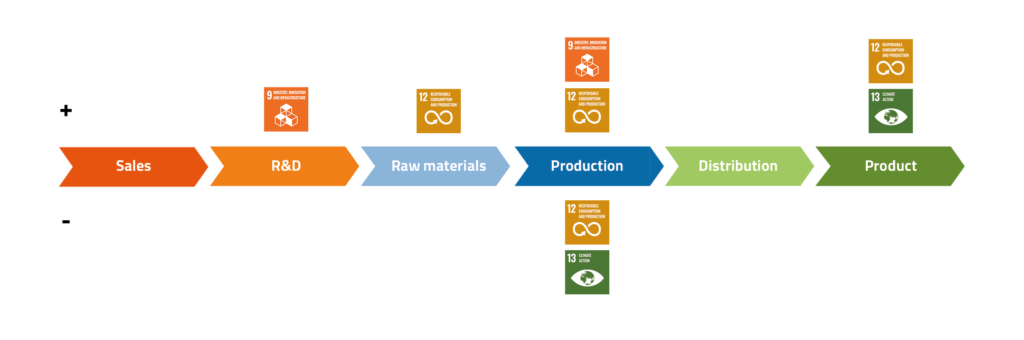
During 2022, extensive work was carried out throughout the organization, with the aim to develop an activity plan (and evaluation plan) which harmonizes with our vision, core values and business strategy. We mapped how our value chain affects the global goals, both positively and negatively. Based on the mapping, a materiality analysis was carried out where three main objectives were identified. These goals are prioritized and integrated into our business strategy, which permeates the entire organization.
Build resilient infrastructure, promote inclusive and sustainable industrialization and foster innovation
Goal 9
In order to meet future climate challenges, we as an organization and a producer want to be involved and contribute to inclusive and sustainable industries. For us, innovation is one of the most important elements and the key to finding sustainable solutions to environmental challenges.
At Svenska Aerogel, we run research and development projects at a high pace. We strive to constantly develop our products and processes to create new sustainable and energy-saving material solutions. We continuously build our competence and seek ideas from external research, patent protection and technical literature.
To encourage the staff’s creativity and willingness to try new things, we have introduced a 5% innovation culture. This means that each person in the R&D team gets to choose an area in which they develop a product and find new applications and properties that benefit our customers.
We believe that team spirit and diversity contribute to a more innovative and creative culture that enables our vision for sustainable and innovative materials.
In our business strategy, we focus on four main customer segments: Building & Construction, Process Industry, Transport and Pulp & Paper. In these segments, our R&D team develops and tailors our products based on sustainable solutions, applications, and products. In order to be in the forefront and to fulfil the market’s needs, we have well established creative and innovative processes within our company. One of these processes resulted in the introduction of an innovative technology called SeaQare, which can be used in antifouling paints for leisure boats to reduce copper release into our seas.
To create more efficient and environmentally friendly production processes, we continuously run internal and external development projects. The aim is to find innovative solutions that reduce the energy and resource consumption from production processes. Here we see that we can make the biggest difference in reducing water consumption and energy use in production.
Within the framework of products and processes developed in the company, patent applications are submitted to strengthen our business. Today, we have five patents and aim for two to three patent applications before 2025.
Goal 12
Achieving sustainable development requires us to reduce our ecological footprint by changing the way we produce and consume goods and resources. The transition to a more sustainable consumption and production is a necessity to reduce our negative impact on the climate, environment, and human health.
We strive for a green economy with a sustainable production and consumption. A green economy where all production and consumption choices are made with the well-being of the society and the overall health of the environment in mind. A green economy that reduces carbon dioxide emissions, pollution and improves energy and resource efficiency.
We manufacture the unique product Quartzene. Quartzene is used to improve materials in various ways – and even give them completely new properties. By adding Quartzene, the end products become more efficient, less material is used, weight is reduced, plastic can be replaced, and energy is saved in several stages.
Svenska Aerogel helps industries to develop new products with properties that shape the future to be more sustainable.
Svenska Aerogel’s concept for manufacturing Quartzene is unique and addresses sustainability at several levels. To produce Quartzene, natural resources are used: silicon, water, and energy in a patented process.
In our value chain, Quartzene has a positive impact on the environment in most stages. However, we have also identified two main environmental burdens – our water and energy consumption. To produce Quartzene, significant amounts of water are used, and the goal is to recirculate as much of the excess water as possible by 2030. By starting to measure water consumption, we can raise awareness about how much water we dispose and create motivation and ideas on how we can reduce water consumption. This also applies to energy use; we will measure all our consumption and look at new innovative solutions to make cost-effective savings.
Goal 13
Climate change is a growing problem, and greenhouse gas emissions continue to increase and can have serious consequences for the environment, our health, and our safety. We have set ambitious goals until 2030. The goals are primarily about reducing emissions in our own production as well as from indirect emissions from purchased energy, goods, and services. To achieve our goals, we will actively work for climate-smart production and set clearer requirements for subcontractors, distributors, customers, and partners. We will also carry out life cycle analyses on our products. Lastly, we will increase the efficiency of our production and recycle more materials, as mentioned in goal 12.
Located in Sweden, we are privileged to have access to renewable energy and to be working innovatively to reduce our climate impact, both in the short and long term. We strive to be a role model in the work of finding innovative solutions both for our own production but also in the customers’ various applications.